
NLP
How can you improve your ability to hear Meta Model distinctions in conversation, even in real time? Perhaps the easiest way is by learning the rules of the radio quiz show 'Just a Minute'.
Just a Minute is a BBC Radio 4 comedy panel game which is still going strong today after it was first broadcast in 1967.
The object of the game is for panellists to talk for one minute on a given subject, "without hesitation, repetition or deviation". The comedy comes from attempts to keep within these rules, and the ensuing banter among the participants, who include well known comedians, TV presenters, writers and other similarly articulate minor celebrities.
The rules of the game give us a very simple way to detect the patterns in spoken language which reveal 'creases' in the underlying mental map which hide information. By revealing that information, the client can make better informed decisions about how to navigate through the world.
Here's an audio clip from another BBC Radio 4 show, Start The Week, which featured a discussion about whether Universities are making too many concessions for the 'snowflake generation' which is impairing their learning. It's less than 2 minutes long and you'll hear the guest answering a question. The question isn't important, what you can notice is the number of times that the guest starts a new sentence without finishing the last one (deviation), non-verbally fills time (hesitation) and makes the same point (repetition). It's a nice example of how the speaker is describing events which are emotionally uncomfortable, and her words reflect the points at which her emotions peak.

Here are some handy online tools that will help you to learn and apply NLP.
The Unsticker
The Unsticker is an online and smartphone app which generates random questions which contain various NLP technique patterns, such as dissociations, shifts in perceptual position, reframes, timelines, submodality changes and more. You can use The Unsticker to get unstuck when you've got a problem, and you can also use it to practice the conversational use of NLP.
Milton Model Generator
Creating complex Milton Model embedded commands in real time in front of a client can be tricky, so this online and smartphone app does it for you. Simply enter a simple command to embed, and the app generates a series of random Milton wrappers for your chosen command, ready to either read to your client, or to yourself, or for you to analyse to practice your language skills.
Online Learning
I've developed some online learning resources for you, currently the NLP Practitioner Foundation is online and free, comprising a series of 8 videos, a downloadable PDF and an online test that takes you through the basics of NLP. If you're a beginner, this will be a perfect, practical introduction. If you have already taken NLP training, why not sign up anyway? You might find you've been doing a few things wrong...
The second course is currently in development, it's entitled 'Decoding Language for Coaches' and it's a non-technical introduction to how to decode a client's language using the subjective transformations hidden within structure, so that you can make an accurate, insightful and revealing analysis of the client's inner representation of reality. In short, the course will enable you to perform magic with your clients.
All of the online courses can be found at the Genius online school.

Your human system, comprising your senses, your brain, your nervous system, your muscles, everything that is 'you', contains two processing systems which work in balance. One is always late, and one is always wrong.
Living organisms are physically build as 'servomechanisms', comprising one or more actuators which can produce an output or action, and one or more sensors, which regulate the output in order to achieve a target state.

A home heating system is a simple example of such a servomechanism. You can set the target room temperature on the thermostat and the system will then regulate itself to maintain that target state.

Imagine a flower. It opens its petals in the morning, and closes them in the evening. How does it 'know' when the sun is out?
The simple answer is that it has cells which respond to light, warmth and air humidity, which create physical changes in the flower, which cause its petals to open or close. Some flowers even seem to 'follow' the path of the sun. Perhaps you've seen time lapse nature documentaries which show this in action.
The flower, or a frog, or a worm, or an ant, is entirely reactive to its environment. These organisms seem to have some awareness of their environment, but it's hard to imagine that they have free will or consciousness in the way that we experience it. However, we tend to project the concept of a mind onto such creatures. We might say that an ant 'wants' to go somewhere, or that the worm 'doesn't like' bright sunlight. Our ability to imagine what other people are thinking doesn't stop with other humans, we imagine that all kinds of creatures have minds, with intentions and objectives, likes and dislikes.
As 'higher' animals evolved, the need for these purely reactive control systems became a limitation. Reacting to the environment is useful, but our reactions are always late. If a predator can react faster than we can, our survival chances are greatly reduced.
What many animals have evolved is a prediction system which can learn from past reactions and identify what could be about to happen, and react ahead of time. We live in a universe of cause and effect. Everything that we can observe and experience is preceded by something else. Rain falls for a reason. When we feel the change in the direction of the wind, and we see the dark clouds forming, we know rain is coming. When we see the buds forming on the trees, we know spring is coming.
If we were to slice your brain in half, we would see 6 distinct layers. At the bottom, we have the brain stem, the most 'ancient' part of your brain in evolutionary terms. This is where basic functions such as breathing, heartbeat, temperature regulation and so on take place. At the top, we have the neocortex, the wiggly outside bit that you've seen many times in photographs.
When a new sensory stimulus arrives, the neurons in your brain pass the incoming signal all the way up to the top level where that signal is processed to create a motor output. You experience something new, figure out what to do about it, and finally you take action.

This process is adaptive and innovative, but it's slow, and it requires a lot of brain power. You could not respond to every stimulus in the world around you by figuring out what to do each time. You must learn to respond automatically, so that when you're driving and you see a traffic light change from green to red, you stop the car without having to think about it.
Thanks to the magic of Spike Timing Dependent Plasticity, discovered through the 1970s and 1980s based on the original work of Donald Hebb in 1949, neurons that are close to each other in the brain will spontaneously connect together when they are activated in a particular sequence and within a particular time window. When one fires just before the other, they connect together and create a 'short cut' which now speeds up the overall connection.
As the input and output signals pass by each other in the brain, the neurons that connect the signals begin to connect together, all by themselves.

As the stimulus and response are repeated, through practice, or through repeated exposure to the stimulus, or through the action of the hippocampus in replaying unusual events, the cross connections reach down into the 'lower' parts of the brain.

Finally, the cross connections exist all the way up through the layers of the brain and the response has now become a physically hard wired connection; fast, but fixed.
You can see the two systems at work here. The reaction system is always late, because the system takes time to react to the stimulus. The process of hard wiring the response reduces that delay, but there's always a delay. The prediction system builds on the reaction system by cross connecting preceding stimuli, events which usually come before the one we're responding to. For example, the first time you hear your boss yelling at you, you feel bad. The more your boss yells at you, the better you get at picking up signs of your boss coming into the office. Your brain connects their voice tone, the sound of their footsteps and other cues so that you can preempt what's about to happen. The problem is, the sound of footsteps isn't what causes your boss to yell at you. Your prediction system is excellent at predicting physical events, such as the motion of a snowball as it flies towards your face, but very bad at predicting external events where another person's free will is involved.
We can predict changes in the weather, or the flight path of a snowball, with a high degree of accuracy, and from this we form the idea of being 'right'. We learn, by constantly shifting our awareness forwards in time, that when a cause occurs, its associated effect will follow. However, this leads to a cautious attitude to events. It's better to be safe than sorry, and the predictive system is self-confirming and self-reinforcing. The simplest way to avoid being wrong is to keep quiet, so we avoid the risk of testing our predictions. Our brain reinforces the instances when we're right, and we become more sure of our predictions.
By predicting the response of your boss, you begin to act as if you're already in trouble, which signals to your boss that you've done something wrong. You actually create the response that you're trying to avoid.
Your reaction system is always late.
Your prediction system is always wrong.
By balancing the two, you're able to navigate the complex, ever-changing world that we live in.

NLP has two language models, the Meta Model and the Milton Model. Find out what they are, how they work and why you might use them in your communications.
Labelling Experiences
How long was your last holiday?
How long did you spend telling your friends and colleagues about that holiday?
Clearly, you missed a lot out. Why?
Did you only tell people about the 'important' events?
Important to you, maybe, and important to the way you want people to see you. You created a trailer for the movie to convey the message you wanted
Through your life, you have made the same edits to your experiences to tell a consistent story about yourself. And sometimes, you might want that story to change.
You can try a simple experiment to test this. Pick two common experiences, such as going to a restaurant, a holiday, a work meeting or a hobby. Ask a number of different people to tell you about their most recent memory of these experiences. Notice how the same patterns show up for each person, regardless of the event they're describing, and notice the differences between different people's descriptions. For example, one person might always talk about the other people involved, friends they made and what a good time they had. Someone else might always talk about challenges they overcame. Someone else might always talk about themselves. Think about why these similarities and differences emerge.
The Map is Not the Territory - Creating Maps
From an early age, we learn to create abstract maps of the world around us. We use these maps to navigate, even when we can’t see where we’re going. These maps also contain people and relationships, and we label our maps with symbols, including spoken and written language.

Our experience of life has too much information to relate to directly, so we simplify our life experiences by deleting, distorting and generalising information.

When we relate to our experiences, we miss out a lot of detail. We act as if our map is complete, but it isn’t. There are significant gaps.
NLP's two language models are based on the deletions, distortions and generalisations that are inherent in our language. These ‘transformations’ are consistent and tell us how a person creates their experience of reality. We can use these transformations to both understand and influence.
With Meta Model, we can understand what someone really means, despite what they say. The underlying message is embedded inside the structure of the words they use, and without realising it, people give away information about their experiences and intentions – the truth always comes out.
Meta Model enables us to discover information is missing so that we can understand the person’s original experience of reality
Milton Model enables us to leave out some information so that the person can fill in the gaps from their own experience of reality.
NLP Meta Model
We are complex animals, able to hold onto multiple goals and interests at the same time. Sometimes, those goals are in conflict and our communication systems are sophisticated enough that we can communicate multiple messages at the same time.
For example...
- We can say yes and shake our heads at the same time
- We can say yes in a quiet, hesitant voice tone
- We can say “for sure”, “100%”, “absolutely” - which sound like yes, but are not the same
These are simple examples, things can get much more complex. Here's an example.
“I need to know”
Need is a ‘modal operator of necessity’, a rule which determines how a future action will be taken. A necessity is external, it’s what someone else wants ‘to know’ is therefore in the future. When we combine external motivation with knowledge, we can see that the speaker is not talking about knowledge in the present, but about being able to use that knowledge in the future for someone else, perhaps to pass a test, or to use in a meeting or presentation. The person has revealed a perceived lack of knowledge compared to someone else's judgement. If we don't take care of the perception of judgement then no amount of knowledge will give this person confidence.
Some trainers and writers have called these patterns 'violations', and on training courses, students have to practice spotting 'Meta Model violations'. This is based on the 'rules' of grammar, and is a misleading approach because it assumes that the Practitioner has the valid map and only the client's map is distorted. In fact, both maps are equally distorted, which is why we cross reference the client's language against their own reality, not against anyone else's.
NLP Milton Model
Consider the following statements
Read these words
You must read these words
It is vital that you read these words
Reading these words is vital
How soon might you read these words?
People who read these words are interesting
If you read these words you might find them interesting
How did you react to each of those statements?
Go back and read them again, and notice how you feel as you read each one. What differences do you notice? Why do you think that is?
Have a look at the following image.

Which station is circled?
You ‘know’ that it is Westminster when in fact, that’s not clear from the map. You do not ‘know’, you’ve added information from your own experience to make sense of the gaps. The map is so distorted that you can't see what any of the station names are, so you use your past experience to restore the information that you assume is missing. This means that you're not reading the external map, you're reading your own internal map, which is always inaccurate and out of date. How many times have you seen some, lost, saying, "It should be here!"
With NLP Milton Model, we deliberately miss out information so that the listener has to insert their own experience. The listener is now responding partly to what we’ve said, and partly to their own experience, which makes it easier for the listener to accept new or challenging ideas.
And only you know how good that feels, right?
The purpose of this is not to influence the person against their will, despite what internet marketing gurus tell you about the power of hypnotic sales language. The use of Milton Model in a coaching or personal change context recognises the simple fact that if someone wants something and they don't currently have it, something is stopping them. That barrier is not any external object or person, and it is not about any lack of resources or opportunities. That barrier is the person's own doubts and fears. Therefore, no matter how much someone wants something, they are also resisting their own attempts to change, and this is where Milton Model can help to ease them past that resistance.
Let’s look at some of the different Milton Model structures and work through some examples.
Modal Operators
Future actions follow rules and conditions. Whenever someone talks about what they will or might do in the future, you'll see a modal operator before the verb.
There are two types; Necessity and Possibility.
| Necessity | Possibility |
|
Externally driven Rules, expectations from others |
Internally driven Choice, plans, goals |
|
Must Need Should Ought Have to |
Can Will Want May Might Would |
The two types of modal operator give us the choice of imposing rules versus giving people choice, for example:
- You must not tell people what to do
- You can always give people the choice if you want to
Which did you prefer?
Mind Reading
Mind reading is vital for the survival of a social species, and many different types of animal have been shown to have an understanding of the minds of others, which we can see as empathy, moral and ethical behaviour, and anticipating the needs of others. In NLP, a mind read is where a person takes that social skill a step further and acts as if they know specifically what someone else is thinking, for example, "I know my husband would love this!" or "I know the boss will be angry when she sees this." In Milton Model, we can use a mind read to introduce an idea as if we knew the other person was already thinking it. They will then typically respond by calling that idea to mind and filling in the gaps so that it does indeed become their idea. You know what I mean?
You know what it’s like when...
I’m sure you realise...
You’ll have had the experience...
You’ll remember...
The listener makes sense of the language by finding a reference in their own experience. You can already imagine how this works.
Generalisations
A generalisation applies to everyone, everywhere always, and a generalisation is interpreted as a specific reference, for example:
Always = now
Everywhere = here
Everyone = me
No-one = me
People want stability = I want stability
Negations
A negation can only exist in language, it cannot exist in experience, for example, don’t imagine a cheese sandwich.
Which type of sandwich didn’t you imagine?
Did you answer, "cheese sandwich"? I asked you which type of sandwich didn’t you imagine, not which type of sandwich I asked you to not imagine. Stop thinking about a cheese sandwich.
A negation cannot exist in the real world, only as the absence of what was or could be there. When someone looks across a town and says, "This used to be all fields", they have a frame of reference, a memory, which you do not. Therefore, you interpret a negation by focusing on what is being negated, as if the negation itself doesn't exist.
I’m not telling you = I’m telling you
I’m not saying that = I’m saying that
This could never happen = It’s happening
Nominalisations
We can do some very odd things with language, so we can change relationships and representations such that they no longer describe observable events, but instead describe our experience of those events. For example, if you imagine yourself meeting some people at work, sitting around a table, and you're discussing an action point which you forgot about, and now you're feeling rather uncomfortable, you might quite rightly want to distance yourself from events. To prevent the scenario playing out to its undesirable conclusion, your brain attempts to freeze the moment in time. Meeting people becomes a meeting, sitting becomes a situation, discussing becomes a discussion.
Your statement becomes "I was in this situation at a meeting where there was a discussion". Now that the actions are disconnected from time, they can no longer change. The speaker becomes passive to events.
Decision = to decide
Organisation = to organise
Feelings = to feel
The decision is made = we decided
As a Milton Model pattern, the nominalisation is used to freeze unpleasant experiences and disconnect from them.
Presuppositions
This is simply what must be true for a statement to make sense.
Make America great again = it’s not great now
When we've finished the next project = we will finish it
By hiring me = you will hire me
Subordinate Clause of Time
We can connect together events which are otherwise unconnected, so one event then becomes a cause for another. Examples include before, after, during, while, since, until, as.
As you read these words, you begin to realise...
When you’re ready to learn, you’ll find it easy...
While you're here, you might as well enjoy yourself.
Since you’ve agreed to meet me, and while you make yourself comfortable, let’s start work.
Selectional Restriction Violation
We can apply qualities to things which can’t logically have them, for example:
- The orange night
- The cheerful table
- The welcoming room
- The comfortable chair
Did you notice that the first example was confusing, and as you read down the list, they became more plausible? If you've never experienced an orange night, you had no reference experience from which to fill in the gaps. However, you are much more likely to have said that a chair is comfortable, so that was much easier to understand. However, the chair cannot be comfortable; comfort is a feature of your experience, not of the chair, and the listener applies the quality to themselves:
Comfortable chair = I am comfortable
An open meeting = I am open
A welcoming discussion = I am welcoming
An important choice = I am important
A valuable discussion = I am valuable
We can therefore project a quality or experience by attaching it to something the listener is aware of.
Comparative Deletion
Words like more, less, better, worse, faster, slower and easier imply comparisons. Often, you'll hear people making statements which miss out the comparison, such as, "my new car is much better". The statement is lacking the comparison, so in order to make sense of the language, you insert the missing information, just like you did in the distorted map example above. You will assume that the speaker means "my new car is much better than my old one", yet it's just as likely that they mean "my new car is much better than yours".
In Milton Model, we could use such a comparison to refer to a comparison which the person doesn't even need to tell us about, for example:
How will you know that things are better for you?
You might begin to notice small changes at first...
I wonder what will be the first example that you can think of?
Milton Model in Practice
In a coaching session...
“You know how, sometimes, you might find yourself feeling nervous about speaking to people, and when you get that feeling, and while you notice how you can breathe easily, and how the warm lights, and the soft chair, and the easy words can come, and after such an enjoyable time, you’ve presented yourself so effectively, don’t you think?”
In a presentation...
“I know you have all travelled to be here, and here we are, ready to listen and share and discover the ideas that, together, will take us forward in the direction that is so important to us, to everyone, to people who know that easy promises lead to hard truths, and to people who can’t see a way forwards, and we hear those people, we hear you, and we will face those powerful truths, and together we can create the future that is right for all of us.”
You can try a handy automated Milton Model generator here: https://www.nenlp.com/milton/
In Summary
Language represents our experience of life.
With Meta Model, we can recover the original experience from fragments of language.
With Milton Model, we can use fragments of language to create a rich, personal experience.
With Meta Model, we can understand a person at a far deeper level than they have ever known.
With Milton Model, we can influence a person’s entire experience of reality, for their benefit.

Some useful and interesting apps to support your NLP journey
 |
|
 |
Milton Model Generator for iOS |
In common language, we often talk about concepts such as self-worth, self-care and self-awareness. Yet these concepts cannot exist in the real, physical world. This is often one of the most challenging concepts for students of NLP to get to grips with.

First, a general concept of the relationship between language and experience. We can represent things and events in language which cannot exist in the 'real world'. If we try and represent some of the ideas in our heads in language, we create a stream of metaphors, which cannot be directly understood by a listener. The listener can therefore only interpret the language if we have enough shared life experience through which to translate the metaphors.
For example, if someone isn't listening to me and I say, "He's as deaf as a post" then a native English speaker will probably understand what that means. However a younger, non-native English speaker might interpret 'post' ambiguously. Their first thought might not be of a fence post, instead a social media post might seem more familiar. How can someone be as deaf as a Facebook post? And yet, in trying to interpret the concept of 'deaf' you are already thinking about how people on Facebook don't listen to each other, how their posts are broadcasts of their opinions, and so on. Through an attempt to understand each other, we have created a new metaphor.
Much of our spoken, and indeed our written language is ambiguous. I can say a word in one way, but spell it in multiple ways, and a word that is spelled in the same way can have multiple meanings. In the 'Milton Model' of NLP, we call these 'phonological ambiguities' and they are used to induce a trance state. Ambiguous words such as sea/see/si or weight/wait need context before they 'make sense'. Other words derive their context from the knowledge of the speaker, such as:
- Cat (an animal)
- Cat (a type of boat, catamaran)
- Cat (a device that reduces vehicle emissions, catalytic converter)
- Cat (a character in the TV series Red Dwarf)
- Cat (a steel cable used to carry overhead electricity, catenary wire)
When a garage mechanic tells you that he's going to replace your cat, that's a very different meaning to the same words spoken by a vet.

Therefore, we make sense of such ambiguous metaphors by relating the sound or the written word to our expectations, which are a mixture of context and previous experience. This is how we are able to make sense of language which, when we look carefully at it, makes no sense at all.
I think you understand that it is not logically possible to carry yourself, because you have no point of leverage with which to pick your own body up off the floor. Therefore the phrase "he carries himself well" cannot be a description of a primary sensory experience, it must be a distortion, a judgement. It is a metaphor for how someone walks and acts. A child, hearing this for the first time, might be confused, and might ask what it means. Alternatively, the child may notice whatever seems salient at that point and attach that observation to the statement. Through this, we each learn what 'professionalism' means, and we each have our own unique interpretation. A manager in a company I once worked for would get very frustrated when sales people didn't show enough professionalism. Everyone interpreted the word differently. It turned out that, to him, it meant dark blue suit, white shirt, dark tie.
Let's assume that language follows a predictable and consistent structure of 'SVO' or 'Subject Verb Object' or 'actor -> action -> thing acted upon', in English at least - many other languages are SOV, the subject always comes first.
| Subject | Verb | Object |
'The cat sat on the mat' has a very different meaning to 'the mat sat on the cat'. If we switch the subject and object around, you might think of this:

However, this arrangement cannot have taken place in the physical world? Why not? Because a mat is an inanimate object. It cannot sit. It can be placed by a person, but it cannot get up, walk across the room and sit on the cat. It has no free will, it cannot act, it cannot logically exist in the subject position unless someone put it there. It is more accurate to say, "Someone placed the mat on the cat", and by more accurate, I mean 'describing a set of real world events that comply with the laws of physics'.
Therefore, every statement relates to something with agency, another thing (a different thing), and a change over time observed taking place between them. According to Noam Chomsky and Stephen Pinker, every language in the world follows the same structure, so we might from that assume that every human being observes physical change in the world in the same way, and describes it in the same way, at least in terms of structure.
We might say that the subject always comes first, so the entity that has intention is the first thing that we comment on, and that is usually the speaker, "I". Some languages omit the opening "I", and if the subject is omitted, it is assumed to be the speaker. "Going to the shops" means "I am going to the shops", for example.
If we substitute a different subject/object in our carrying example, based on the above assumption, e.g. the suitcase carries itself, we can again observe that this action can't exist in the world. A suitcase cannot carry itself.
I can imagine a marketing agency coming up with some kind of suitcase with an electric motor and advertising it as 'the suitcase that carries itself' but that is obviously a distortion, the suitcase is not carrying itself, it is rolling on motorised wheels. Carrying is the human action being replaced by the wheels. The case is not carrying itself, but it is doing something as a substitute for being carried.
Now if we substitute 'action' for 'carry' based on the assumption that the above structure always applies, we get 'thing 1 action thing 2', e.g. the suitcase acts upon the suitcase. When you picture this abstract example, you see two different suitcases, yes? And you replace 'acts upon' with something that one suitcase is doing to another.
How about 'the person acts upon the person'?
Again, you see two different people, yes?
How about 'the person cares for the person'?
'I' and 'myself' or 'me' are self references that can occupy either the subject or object position, but not both in a single verb structure, simply because that would require the same person, at the same time, to be both the actor and the thing acted upon.
"I carried the suitcase"
"The suitcase carried me"
Both examples can be described in the physical world. I carried myself cannot.
The laws of physics exist in the real world, yet in the subjective, distorted world of my internal reality, I make judgements and descriptions of events which cannot take place in reality, they can only take place in my imagination. Those laws don't change depending on what word we're using. The structure of experience for "I hit him" doesn't change when we change the word to "I hit me". We can change the word, we can distort the meaning to make it fit, to 'make sense' of it, but that doesn't change the laws of physics.
In computer programming, I can say "The document is sent by magical fairies to the printer" but that doesn't make it happen. The following piece of computer code would make something happen:
<?php
print "Hello";
?>
Well, I said that, and my printer isn't printing. What the hell? It didn't work. I said print and my printer doesn't work. Nothing is happening. It's broken.
A programmer might say, "Well, that's not what print means, print means send to the standard output, if you mean print on your printer, that's more complicated you need to...." etc.
The key is reproduceability. Could we write a software program that will always work, will always do what it is asked to do? For example, add two numbers and display the result. Regardless of the numbers I feed in, will it always work? Or does it only work with some numbers, with the 'right' numbers? Does it sometimes not work at all, or display the wrong result? And does it then say, "Well, that's not what I meant".
No, if we write a program that allows the user to input two numbers, and the program then adds those numbers and displays the result, the function of the program would be consistent, reliable, and wouldn't change depending on what numbers the user entered.
Our goal with modelling in NLP is reproduceability. What are the conditions under which a person would always get the intended result, regardless of input?
Could we write a program to care for someone? Yes, if we very strictly define first what that means. If we know what 'print' means, we can get a predictable result. If we know what 'care' means then again, it's predictable. Could we therefore program a medical robot to provide care? To do everything that a human nurse could do? Probably, yes. But would the robot 'care' in the way that a human does? Would the robot experience caring? Let's assume 'no'. But then, why would we want the human nurse to 'care'? We want him or her to provide care, but I'm sure that many very good nurses, doctors and vets actually don't care about their patients, because that would make the job far too traumatic for them. We talking about the caring professions, but we need to focus on the actions of care, not the intentions.

Let's try another example, "I made myself a cup of tea". If I observed you, I would see you 'making' a cup of tea. I would not see your intention. What if you made it with the intention of drinking it, then someone else drank it? An observer might say "He made tea for someone else" because that was the observable sequence of events. Intention is not visible to an observer. The phrase I often hear at home is, "I was going to do that" or "I was about to do that". I can only observe action, not intention. It would be more accurate to say, "I had a thought about doing that but didn't put that thought into action".
Your intention cannot be observed, and so only exists in the way you compare experiences to form judgements. Eating organic soup is 'self care', whereas eating chocolate is not, for example. On the other hand, eating anything at all, whatever it is, is surely 'self care'. Breathing is 'self care'.
So does care mean what I think it means? Or does it mean something else? Is care a way of saying "takes care of my physical and emotional needs as if I am valuable"? And if that is the case, can I say, "I care about I" or "Me cares about me"? I can say it, but does it means what I think it means? How about "I care about me".
If we're picky we could say that I and me are two different words and therefore different things. I can act. Me is passive. I sits in the subject position, with free will. Me sits in the object position, as the passive recipient of an action. We therefore need to split "I care for me" into its physical world sequence: "I care for x and x cares for me". Does that not describe a normal relationship? Because two people are now involved, both can care and be cared for at the same time. When we take away person x, when they are no longer available to care, and we try to replace that by looping the sequence internally, we loop the program back in on itself. In computers, that will usually cause a crash or a race condition. "A race condition is an undesirable situation that occurs when a device or system attempts to perform two or more operations at the same time, but because of the nature of the device or system, the operations must be done in the proper sequence to be done correctly."
Perhaps I and me are two different entities. Perhaps I is the intent, the actor, and me is the recipient, the sensor. But they are inseparable within us.

How about "I feed myself". We say it about babies, because as with the self-carrying suitcase, the baby learns to do something that the parent had previously done. For a few weeks after the baby first grabs the spoon, the proud parent says, "She's feeding herself now!" but as soon as the novelty wears off, that changes to, "She's having her breakfast".
The baby is eating. The child is eating. The adult is going out for dinner. I can't imagine that you have your lunch at work and people say, "Aw, look, you're feeding yourself". Your first reaction on reading these words is to imagine it. After that comes the tension of being mocked, because that is one interpretation of the scenario, one explanation for why someone would say that, and finally comes the joke to break the tension and restore control, to put I back in the subject position.
The problem in all of this really arises when we take a higher level judgement, based on "when I felt cared for in the past, these are the kinds of things that someone did for me, and when someone doesn't do those things, they don't care about me" and we then directly translate that abstract, distracted commentary back into primary, concrete, sensory reality. You only have to spend 5 minutes on Facebook to see people arguing over such subjective distortions of reality. And to reiterate the point I made in the group, counsellors and therapists are trained to interrupt people from getting lost in their distortions and ground the client back into "What actually happened? What did you see and hear? How did you feel? What must your experience or expectation be for you to feel that way? Are there other ways to feel? Could it have meant something else?" and so on.
Where does all of this leave us with self-worth, self-care and self-awareness?
You cannot value yourself, because you cannot be both the valuer and the thing being valued at the same time. Every major religion in the world seems to advocate the same message; if you want to know your worth, do something valuable for others. If you want to feel loved, love others. If you want to feel cared for, care others. Charity, giving and helping seem wired into our basic social instincts.
How can you care for yourself? If you cared for yourself, you wouldn't need others to care for you. Perhaps self-care is a substitute for being cared for. Which would you prefer? A mutually supportive relationship is one in which I care for you and you care for me; we take care of each other. You physically cannot 'watch your own back', and every police, military and superhero movie has a theme of people being responsible for each other's safety.
The self-help industry (don't get me started on that one) promotes self-awareness. I put it to you that there can be no self-awareness, there can only be awareness of others. By being aware of others, and the impact that we have on others, we become more aware of our effect on the world.
The simple concept which I have attempted to explain here is that the physical world contains objects which interact, and as humans we perceive those interactions as taking place in time, and we describe those interactions using language. Language distorts what we have observed, but those distortions cannot change the physical world, even though we often pretend that they do. We think that ignoring a problem will make it go away. We think that hiding a mistake will correct it. We think that arguing over religion and politics actually changes anything.
We can, of course, change the world, but to do that, we have to be much more specific about what we actually intend to do, and then we have to do it.
----------------
Learn more about the weird structure of language and how to understand what people are really saying in my amazing online training course 'Decoding Language for Coaches'.
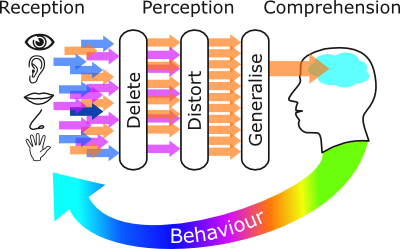
The fundamental principle of NLP is that our experience of reality is not created 'out there' in the world, it is created through a series of subjective processes so that we each create our own personal reality. Conflict arises when our separate subjective realities have no common ground and we are left unable to communicate with others. But how do we know what is being lost or changed as information enters our personal, individual experience?
In any good NLP training, you will learn about three 'perceptual filters' which reduce the complexity of the outside world to something that our limited nervous systems can cope with. There is more information available in the world than we can process - in fact there is more information in the world than we have senses to detect, which is why scientists build instruments to detect events which we are otherwise unaware of. For example, you can't see ultraviolet light, although you will feel its effects after a day in the sun.
For events in the world which are within our range of perception, detectable changes are converted by our various sensory systems into electrochemical signals conveyed along nerve fibres to the brain. Whether you're sending heat or pain or red or music or a tickle, the signals reaching your brain are identical. What makes the difference is where those signals enter the brain, so if the signals arrive in the visual cortex, you see something, and if the signals arrive in the auditory cortex, you hear something.

It's hard to track down where the idea of sensory filters first came from. The idea is connected to the field of Transformational Grammar, which studies the relationship between your sensory experience and the words which you use to describe it. The transformations are consistent, and so by paying attention to the structure of language, we can deduce the underlying patterns which determine a person's behaviour.
This concept of sensory filters makes it easy to understand how we reduce our life experience into something memorable and manageable. As a NLP trainer, I can easily demonstrate the presence of these filters, for example by asking you to notice the feeling of your feet on the floor, and to then notice that you were not aware of that sensation until I pointed it out to you.
The drawback of this concept is that it is simply not true, and is therefore misleading. When I say it's not true, I mean that there is no known structure in the brain which filters information, however if you remember any event in your life, there will be missing information. By examining what's missing, we can say that you have deleted information, but to delete means that we took an action to remove something. Your emails don't delete themselves, you have to press a button or click a link. However, you are unaware of most of the emails in your inbox, simply because you're not paying attention to them. You didn't take any action to delete them, you simply don't look at them.
Delete, distort and generalise are philosophical distinctions, they do not relate to any neurological process. We remember only part of what we experience as life. The important question is, which parts do we remember and which parts do we forget?
In NLP, the most important tool that we use for understanding these subjective changes is the Meta Model, which is derived from the field of Transformational Grammar. If someone recalls a meeting with their boss as a still, blurred, distant image then we know that the visual memory has been distorted from its original form. Changing a moving process, "meeting my boss", into a still image, "a meeting" is called a nominalisation - a verb transformed into a noun, an action that has become a thing. Like a movie transformed into a marketing poster, something has clearly been lost from the original.
Some NLP trainers have tried to put the different Meta Model patterns into categories, and quickly get stuck because there isn't a neat alignment between the two. For example, is a nominalisation a deletion, a distortion or a generalisation? The answer is blindingly obvious - it's all of them. These three imaginary filters are inseparable. Each Meta Model pattern is the result of an experience being 'filtered' through all three. Every statement that you hear has been deleted, distorted and generalised. Every memory in your head has been deleted, distorted and generalised. We really can't say where one filter ends and the next begins, simply because they are not real, physical structures.
The delete, distort and generalise filters are analogous to software filters in your computer - they act as if a real filter is there, and if we compare the input and output signals then we can see that something has changed.
It's difficult to explain this without getting 'technical' so I'll try using a music analogy. If you look at a typical set of hifi speakers, you'll see that each box has two speaker units in it, called drivers:

The big driver handles the low notes and the small driver handles the high notes. If you put your ear next to your own speakers, you'll hear the difference. Big drivers are bad at producing high sounds, and small drivers would be damaged by the low sounds. Therefore, we need a way of splitting the audio signal and sending only the high notes to the high driver, and the low notes to the low driver. This is achieved using a 'crossover', which looks like this:

The components in a crossover work together to allow through some frequencies and block others. In electronic terms, we call this type of circuit a 'filter' because that's what it does.
Now let's have a look at some music. Of course, you can't 'see' music, so this is a visual representation created by my computer:

I can get the software to block out the low frequencies which it does only by performing mathematical calculations on the numbers which represent the music. The result looks like this:

You can immediately see that it looks different. But can you hear the difference? Here are three examples of the same piece of music for you to listen to; one is 'normal', one has the low notes blocked out, and one has the high notes blocked out. This is exactly what the speaker's crossover does.
Normal
Low notes only, high notes blocked out
High notes only, low notes blocked out
Here's the main problem - there is nothing in my computer which looks anything like a crossover filter. It simply doesn't exist. However, its function can be replicated in software. We can hear the effect of the filter, even though the filter doesn't actually exist anywhere. We can talk about the difference between the musical samples as if they have been through a crossover filter, but they haven't. The software control is even called a filter in the menu. But it isn't a filter. It's a set of mathematical operations which produce an effect similar to that of a filter.
Here's another problem - when you are listening to music through your hifi, you can't actually hear the distinct groups of frequencies coming from the different drivers. Your ears and your brain merge it all back into one auditory experience. You hear the music, not the frequencies. The filters did their job in sorting the sound going to each driver, and then that process was lost again. It became inseparable from 'reality'. In the same way, you can never be fully aware of the action of your sensory filters because they are your reality.
And, at the same time, they don't exist at all.
Now, you might be thinking, "If it acts like a filter, and sounds like a filter, then it is a filter". However, that's far too simplistic a view. Anyone who believes that music printed onto vinyl has a quality which cannot be replicated by CDs or mp3 files will understand the difference. The CD recording is measurable better, but the vinyl recording is tangibly nicer.
How do we bring this back to the study of NLP?
In cooking, I know that an egg will 'solidify' a recipe. However, putting an egg into a falafel mix is OK, whereas putting it into a watery tuna curry is not. I know this from personal experience. Egg, tuna and curry powder do not mix. Just because ingredients have a similar effect does not make them interchangeable, because the effect is dependent on the context. If, as Practitioners, we believe that our clients have in-built filters which delete, distort and generalise, we might fail to notice the specific transformations which are taking place. To categorise these processes as deletions, distortions and generalisations is itself a generalisation. It's really not that simple. It is far simpler.
How do we know what is being lost or changed as information enters our personal, individual experience?
Imagine you're working with a client. Imagine that they're telling you about their frustration at work. Endless meetings. Indecision. An atmosphere.
Instead of diving into problem-solving mode and exploring their 'values', stop, step back, get a comparison. Ask them about a wonderful day out they've had to somewhere special. You'll hear active verbs, movement, time passing.
Now you have a comparison. You cannot know what the 'problem' is without a frame of reference. If you only hear the client's first story, then you are using yourself as the point of comparison. You're coaching yourself!
By the way, this, in NLP terms, is calibration. If you've come across calibration before, you've probably heard of it as a method of noticing the client's rate of breathing and their pupil dilation and the movement of their eyebrows. This is nonsense. This is not calibration. Just think about what the word means:
calibrate
/ˈkalɪbreɪt/
verb
- mark (a gauge or instrument) with a standard scale of readings
- correlate the readings of (an instrument) with those of a standard in order to check the instrument's accuracy
- adjust (experimental results) to take external factors into account or to allow comparison with other data
To calibrate, you need a fixed point of reference, which cannot be you, because you're not the standard for the perfect human. You can only calibrate a person to themselves, by testing when their responses change in relation to their environment. When do they feel this way? When does it start? When does it stop? Are there any exceptions?
When you calibrate by asking your client to tell you about two contrasting experiences, you can hear that time is passing for an enjoyable experience, and time seems to stand still at work. Duh, of course. Isn't that true for everyone? First, no. Second, it doesn't matter what other people experience. We're interested in what this client experiences, why, and how their memory of a day at work differs from the reality of a day at work. They describe a still image, but they must have experienced a moving image. They describe time standing still, but time must have passed. Why are they distorting their experience? How does this serve them?
If the client says, "Nothing interesting ever happens", we can hear a generalisation ("nothing"). So what? Well, we are not hearing a generalisation, we are hearing a difference between the word and the experience which it must describe and we are calling that difference a generalisation. The difference is subtle yet very important. The client did not generalise their experience. We heard an effect which we are labelling 'generalisation'. The client is telling us, in the structure of their language, that they want their work to be interesting, and that's not how they feel about it. That is not a problem with the nature of their work. That is a problem with the client's expectations.
When we listen carefully to the structure of the client's language, we can hear words which cannot logically describe an experience which exists in this universe. Time cannot 'stand still', yet we can talk about it in that way.
We can describe the effect of this as being a distortion, or a deletion, or a generalisation. It doesn't matter. You can describe the effect of someone with a high pitched voice as if they have a high pass filter, but they don't. It just sounds that way.
As a NLP Practitioner, you will be more effective when you distinguish between the reality of the person sitting in front of you, and the generalisations taught by other people in the past - even when those generalisation work their way into the folklore of NLP.
Remember, the concepts of these filters was created by philosophers back in the mists of time, not by neuroscientists studying brain structures. We talk about them as if they exist, and we talk about all relationships as if they exist. What we're actually noticing is difference - the difference between what someone said, and what we think they should have said; what we think makes sense. Once again, in trying to understand perceptual filters, what we're actually revealing is our own subjective reality. Remember that in order to see your client's distortions, you are first looking out through your own.
If you’ve attended any NLP training or read any other books, you’ve probably come across the idea of ‘calibration’.
In the early 2000s, I attended a short NLP course where the trainer had us work in pairs, standing a few metres apart whilst holding up one of two coins to see if we could tell which was which.
We would then move further apart to find out how far away we could stand and still tell which coin was being shown. We were all delighted to discover that we could tell the difference between a 1p and a 2p from across the other side of a hotel conference room.

I can’t tell you the number of times I’ve used that skill in a coaching session, or when developing leaders in business.
Oh, wait, I can. None.
The trainer lists the following as useful things to notice from your client:
- Blink rate
- Breathing rate
- Heart rate
- Facial circulation patterns
- Pupil dilation
- Nostril dilation
- Eyebrow movement
- Lower lip swelling with blood
You might be thinking to yourself, “Wow, that seems like a lot of hard work. How can I pay attention to all of that and still listen to what the client is telling me, and think about where I’m going with my questions, and keep an eye on the clock, and, and, and…”
You would be right to have these concerns, because this is not calibration. Let’s look in the dictionary:
calibrate
verb
1. mark (a gauge or instrument) with a standard scale of readings
2. correlate the readings of (an instrument) with those of a standard in order to check the instrument's accuracy
3. adjust (experimental results) to take external factors into account or to allow comparison with other data
How do you know that your tape measure or ruler is measuring accurately? Of course, that’s a trick question. You know that it isn’t accurate. A better question would be, how do you know that your tape measure is accurate enough for your needs?
Tools such as tape measures are calibrated in the factory by comparing them to a reference, and that reference is in turn calibrated. You can follow a chain of measurements all the way back to the standard metre which sits in a secure storage facility in France. Each time a measurement is compared, an error is introduced. Is that measure significant? If you’re using your tape measure to measure your room for a new carpet, it could have an error margin of perhaps 2 or 3mm and make no difference to the fitting of the carpet. However, if a professional carpet fitter measures your room, he or she will round up their measurements. Are they trying to con you into buying more carpet than you need? No, they are making an allowance for the inaccuracies of their tape measure, your room and the carpet factory.
What defines a metre or a second or a litre? Only two things; a consistent way of measuring such things, and an agreement amongst the people using the measure.
To calibrate to your client, you need a fixed point of reference, which cannot be you, because you’re not the standard for the perfect human. Your client’s pulse is 93 bpm. So what? Is that normal?
You can only calibrate a person to themselves because there is no other reference for their ‘normal’. Do this by testing when their responses change in relation to their environment. When do they feel this way? When does it start? When does it stop? Are there any exceptions?
To calibrate as a Master Practitioner, you will ask referencing questions which enable you to establish how your client’s perceptions change from one situation to another.
Imagine that your client is talking about how they feel at work. If you think, “Oh dear, that sounds awful for them” then you are making a judgement, and a judgement is based on a comparison, and then you have to ask yourself what or who you are comparing them to. If you are imagining how you would feel in their shoes then you are making yourself the point of reference, and your judgement and therefore your response is based on the difference between what the client is telling you about their situation and how you would feel in their situation. In order to know how you would feel, you will recall a specific situation which you’ve been in which seems similar and compare to that.
In other words, you’re coaching or modelling yourself, not your client.
Calibrating to your client means that you’re asking them to give you points of reference that are in their map, not yours.
Imagine that we’re talking about a literal map. Your client says that it’s 5 miles from where they live to where they want to go. Is 5 miles a lot? Is that a long journey? Is it going to be a problem?
A simple calibration question in this instance is simply to ask them, “What does that mean to you?”, though that only gives you a judgement, not a point of reference. You would therefore follow up with, “What would you consider to be a short journey?”, and, “What would you consider to be a long journey?”
Now let’s imagine that your client is telling you how they feel about their work. We might ask them to describe a typical day, but also their best and worst days. We might ask about their days off, their weekends. It’s like a dot-to-dot puzzle that you probably enjoyed as a child. When you have enough points of reference, a picture emerges, and the most critical point to remember is that this picture is their picture, untainted by your experiences and expectations.
When you calibrate by asking your client to tell you about two contrasting experiences, you might hear that time is passing for an enjoyable experience, and time seems to stand still at work. Duh, of course. Isn’t that true for everyone? First, no. Second, it doesn’t matter what other people experience. We’re interested in what this client experiences, why, and how their memory of a day at work differs from the reality of a day at work. They describe a still image, but they must have experienced a moving image. They describe time standing still, but time must have passed. Why are they distorting their experience? How does this serve them?
We know that the client’s memory will be distorted compared to their real time experience of work. How do we know this?
Firstly, because the foundational premise of NLP is that all experience is distorted in some way – that’s what makes it subjective.
Secondly, we must continually ask ourselves the question, “Why are they telling me this?” Why tell you about this day? Why not another day? What makes this day so special? This day is being marked out simply because they are telling you about it. They did not pick a day at random.
When we calibrate, we are working only within the client’s map of reality and we are orienting ourselves to that rather than using ourselves as a point of reference. Your reality is irrelevant, unless it’s you you’re trying to model or change.
I’m not going to list calibration questions for you to repeat like a parrot, because the principle is what’s important. If you watch any of the coaching demonstration videos on my YouTube channel at genius.li/youtube then you will see examples, at the start of each conversation and then again when anything changes. Each time the map changes, you’ll see me reorient to it. Some coaches might call this ‘checking in’ but in the spirit of modelling, what exactly does it mean to ‘check in’? Having recognised a change in the client’s map, evidenced by a change in their perceptions and responses, you go back to the beginning and identify points of reference in their map.
One of the most common questions that I head from NLP trainers and coaches is “How will you know when”. For example, a client might say, “I want to be more confident”, and the coach asks, “How will you know when you’re more confident?”
Let’s break down what’s happening here. When the client says “want” they are referring to what they perceive is currently missing, and they can only know what is missing through a comparison – either they had it in the past, or they have seen someone else with it. When that’s a shiny new car, the comparison is obvious. When it’s an intangible quality such as confidence, that is of course a judgement based on a comparison. I can see that person doing what I stop myself from doing, they must have confidence, and I must be lacking confidence. This is also very likely to be a phrase that they have heard from someone else. Imagine the effect when a parent says to their child, “You’re just not confident enough”. This gives the child, and then the adult, an explanation for why they don’t do the things that other people do.
When the coach then responds with the magic “How will you know?” question, they are creating a sales pitch. The question is designed to have the client imagine a goal, to visualise a time in the future when they have confidence. This gives the coach a ‘product’ to sell to the client, but it’s counter productive. When the coach asks the client to imagine a time in the future when they have confidence, the coach is saying, “Confidence is a thing which can be possessed and you do not have it”.
Wow. The coach, through that innocent question, actually reinforced the current state.
The word “have” is interesting too. It pretends to be a verb but it isn’t a verb. As you will discover in the next part of the book, it is not a verb but a statement of possession. You have confidence. Great. How did you get it? Where did it come from? What steps would you take to get some more of it? Where can someone else get it from?
Until we answer those questions, there is no solution.
By the way, confidence means “with trust” (con fide, Latin). It’s not something that you can have or possess. It’s something that someone else shows in you. If you want confidence, act in a way that gets other people to trust you.
When you ask a calibration question, your client will recover a memory, and that memory will set off a chain reaction of events. They will respond, physically. They will replay conversations. They will see something in their mind’s eye. They will respond emotionally. All of this is visible to you, because these sensory events are designed to produce motor output, which means that you will observe the effect of that motor output in the client’s body. You don’t have to study their eyebrows or ‘facial circulation patterns’. No, I don’t know what that is either.
If the state change isn’t ludicrously, blindingly obvious, you’re asking the wrong question. When we calibrate, we look for clear, unambiguous state changes. If you’re studying your client’s neck closely enough to see their pulse, you’re missing everything else that they’re doing, and when you make your calibration questions clear and purposeful, they will scream the answer with every muscle in their body.
I’m probably making it sound like calibration questions are some kind of amazing linguistic trickery. That’s really not the case. If the client is talking about problems in their main relationship, I might ask, “Tell me about a typical event that you’re not happy with”. Then I might ask, “Tell me about an event that you were happy with”, or, “Tell me about a different relationship that you’ve been in”. What you’re always doing is creating contrast.
Modelling a high performer is no different. “Tell me about a presentation you’ve given that went really well”, “Tell me about a presentation that went not so well”, “Tell me about the best presenter you’ve ever seen”.
Make the difference so great that the change in responses is obvious and calibration will always be easy.
Mariana


Nicholas


If you've studied or read about NLP then you have certainly come across the concept of rapport. Sadly, most NLP trainers are still teaching the concept in a way which is fundamentally misleading.
For decades, NLP trainers have been teaching students to match and mirror the body posture of a person who they want to 'get into rapport with'. This in turn has contributed to a perception of NLP as being manipulative, a tool to be used to influence someone to like you in order to coerce them in some way.
Firstly, this is simply wrong - if other human beings are, as Scott Adams puts it, 'mindless dolts', so easily influenced, then so are you. The amount of effort and time required to influence the way that someone thinks and behaves is far beyond the scope of, say, a sales meeting or first date. The marketing gurus who promise to teach you the secrets of hypnotic influence are trying to use it on you. How's it working out?
Secondly, rapport isn't something that you consciously create, it's already there. The mistake that generations of NLP trainers have made is to think that rapport is something that happens between two or more people when, in fact, it's more accurate to say that rapport is a connection that is formed between two or more people and their environment.
Yes, it's obvious now, isn't it? Human beings are connected to and woven with their environment. Your senses are systems for gathering information about your external environment. You turn your head when you hear your name, a bright flash of light catches your eye, you move when you feel something brush against your leg. Our mind and body and comprised of two fundamentally opposed decision making systems; one is predictive, trying to guess what will happen next, and one is reactive, trying to catch up with what just happened. Your experience of 'now' is somewhere between the two.
How do you know when you are in rapport with someone? It's a sense of being 'like minded', on the same wavelength, right? And how do you know that? Because you see the other person responding to the same environment in the same way as you. Your responses are synchronised, and over time, the activation patterns in your brain become synchronised.
Therefore, you don't get into rapport with someone by copying what they're doing, because what they're doing is in response to the environment that they're sensing. OK, so if you copy them fast enough, they might at an unconscious level think that your responses are aligned with theirs, however in reality you'll always be too late because your reactive system is laughably slow. When you think you're responding instantly, you're actually a second or so late. You might not think that's much, but try crossing the road and dodging an oncoming car a second too late and see how it feels.
The delay is long enough to alert the other person, consciously, to what you're up to. Hence, the professional buyers in large retailers receive training to help them spot the matching and mirroring training received by the sales people who are trying to influence them. Seriously!
Genuine rapport is built when two or more people, in the same environment, experience the same sensations and respond in the same way, at the same time. When this happens, what do you do? You look at each other in surprise and laugh, right? And that experience brings you closer together. This might be why horror movies are such a good way to build a romantic connection. "Oh! We both jumped out of our seats at the same time! How cute!" A shared experience is a shared inner experience as well as an external one.
In a crowd of strangers, what makes you feel drawn to some people and not others? At a networking event, what makes some people seem more approachable than others? I propose that it is a sense of shared connection to the environment, judged on the basis of the people who look how you feel, the people who are responding to the enviornment in the same way as you are. Like minded people.
Humans - in fact, all forms of life on Earth - are inseparable from the environment. You cannot physically disconnect, ever. You are always seeing something, hearing something, feeling the ground beneath your feet, the air on your skin. Our senses connect us through this environment to each other. Only are minds can detach from the outside world, by creating new sensory worlds that only exist on the inside. For example, when you're dreaming. Now, if you shared a dream with someone, how powerful would that be? Some night take this as proof of telepathy, others might say that if two people shared the same real-life experience, they would probably have a similar dream featuring that experience. For people who live together, having different dreams might be more unusual.
Your brain is a decision making system which, in part, supports the prediction system that we could call the mind. Your mind remembers, compares, analyses and attempts to figure out what's about to happen, keeping you safer by being one step ahead. Your mind increases the chances of those predictions being right by testing out multiple possibilities. This is so woven into your experience of life that you don't even notice it. You do it when choosing from a menu in a restaurant, and you do it when mentally rehearsing a conversation with your boss. Your mind can simulate multiple realities, and your body then takes action and one of those possibile realities takes form in the physical world. In other words, you tell the waiter what you would like, or you walk into your boss' office and start talking. As soon as your muscles move, your dream becomes reality.
When your brain is synchronised with another person's, you feel like you could guess their responses, you could predict their actions, and you would probably be right. This is because their mind is making the same predictions as yours, using the same raw data. Put the same numbers into two different calculators and you would be surprised if the results were not the same.
So instead of looking to others for rapport, look to the environment. Notice the forces acting upon you and respond to those, first. Your brain will fine tune the details for you.
If you follow the teachings of many NLP trainers and authors, you'll be copying the actions of the person you want to influence. First, you won't be paying attention to how much they're influencing you, as rapport is a cyclic process, not one way. Second, you will by definition be copying them around a second too late, and that incongruity will alert their conscious minds to the fact that you are trying to copy them, which is counter-productive.
How, then, do you 'build rapport'?
Imagine you are in a room with a number of people. None of you know each other. One of them has her arms and legs 'pulled in' and is rubbing the outsides of her arms. You surmise that she looks as if she feels cold. Do you start copying her gestures? What if you say, "Chilly, isn't it?" You have side-stepped the issue of timing by commenting on what you imagine she is experiencing. You will have seen
Imagine you're sitting on a train. Opposite you, a young man is resting his chin on his hand, staring out of the window with a far-away look in his eye. You could emulate his pose, but for what purpose? What would he think? Instead, you might say, "I wonder if they're thinking about you too?" How surprised would he be that you could read his mind?
My suggestion is that we cannot 'create' rapport, it is already created for us. We cannot 'build' rapport by copying a person's gestures, because our gestures will lag behind theirs by a long enough delay that they will notice, and that will break rapport. What we could do, which neatly takes away the timing issue, is to comment on the environment in a way which creates a sense of shared experience. To comment means that we have noticed, and to notice is to join in the experience. In NLP and hypnotherapy, we call this 'utilisation'.
You might also like to watch a video on this subject, which is the edited highlights of a NLP Graduate Group session from January 2021.
If you've been looking for NLP Practitioner training, you have probably come across adverts for low price, instant gratification online learning, run by people claiming to have any experience of NLP credentials.
The coaching industry is one of the fastest growing industries on the planet and the demand for skilled coaches is going through the roof.
Being a coach is one of the most rewarding, exciting and fun things you can do.
Whether you become a full time coach who makes a living by alleviating suffering and helping peoples dreams come true…
Or use it as a skillset part time that pays for holidays or gifts for the kids…
…it’s an amazing way to make life more meaningful and develop a sense of pride about the impact you have on others.
Especially if you are already passionate about your own personal development, want to leave a legacy and enjoy learning.
But this presents a problem…
There are many, many “overnight” experts on coaching claiming to be able to help others become world class coaches.
They’re only in the industry because they are trying to seize the growth in the coaching space and profit from it.
And therefore they’re charging thousands, if not tens of thousands, for wishy-washy, shoddily put together programmes that won’t help you transform a client…and possibly even make the clients life worse.
I’m here to put a stop to that…
See I’ve been involved in the coaching industry since the late 1980s (way before it was cool to be a coach and way before the coaching industry was booming like it is now).
I’ve won awards for my services to the coaching industry (more on that shortly) and have been involved with the industry as a coach and trainer of coaches for decades.
Changing lives, and helping others develop the skills and confidence to be able to change lives too, is my passion and I hate to see opportunists jumping into the coaching industry and taking advantage of something I love and good people who just want to help others.
And that’s why myself and my team are doing something crazy…
I'm On Mission To Disrupt The Coaching Industry
I’ve been around the block long enough to know how this goes…
Because coaches are becoming more and more in demand these “overnight” coaching experts will be able to justify high prices for their coaching certifications.
And then the prices to become a certified coach will go up…and up…and up…
Before you know it the price to become a certified coach will be so astronomical there will be less and less coaches out there helping people because certifications will be beyond their reach.
I’m on a mission to stop that…
For YEARS I charged $697 for the exact same certification I am willing to let you have for just $7.
Less than two cups of coffee at Starbucks.
I realised I could either up my prices, like others are doing, or go the other way and charge far, far less than the opportunistic “overnighters” ever would.
Will this make me popular with them?
No.
Does it make me proud that I can continue to help create world class coaches at a price anyone can afford?
You bet!
Is Becoming A Coach Right For You? Here’s A Simple Way To Figure That Out…
You’ve landed on this page because you’ve seen one our of online ads or read about what we’re doing somewhere that we have been mentioned.
You understand our mission, to save the coaching industry from greedy predators and continue to create world class coaches without the sky high fees.
But how do you know if becoming a coach is right for you?
Well in my experience you’re an ideal fit if you fit any of these criteria below.
And if you tick three or more - you may have just found a new calling in life.
Go through the list below and see if any of these resonate with you…
You want to live life to the full
You are interested in how the mind works
You want to feel valued
You want to leave a legacy
You want meaning and purpose in your life
You want to grow and develop
You want to learn
You want to have freedom to live life on your terms
You want to make the world a better place by alleviating suffering
You want to be proud of yourself
You fear not loving who you are
You fear missing out and life passing you by
You fear staying stuck in an unfulfilling job
You fear living below your potential
You fear not feeling good enough in life
You fear being ordinary and average
You fear not being excited and hopeful about the future
You fear regret
You’d love to be paid for work that matters
You’d love to be able to control your own emotions and help others do the same
You’d love to be able to look back on your life and think “WOW!”
You’d love to get paid to help the dreams of others come true
Now, you may read through that list and think “Everyone will tick one of those boxes” - but you’d be wrong.
Most people just want an easy life in the same career and are happy doing the same thing day in day out.
They never think about life passing them by or how they could be missing out on a more exciting and fulfilling career or not living up to their potential.
I’m guessing if you’re here, though, that’s not you.
My guess is that, like me and over 56,000 coaches I’ve certified, you want to live a full and exciting life and that list above speaks to you on some level and coaching others part or even full time could be ideal for you.
So, whilst £1095 is within reach of everyone, let me just put your mind further at rest before telling you exactly what you’ll gain immediate access to when you sign up…
Why Learn From Me? Undeniable Proof…
Remember how I said that the skyrocketing demand for coaches has led to many pretenders and opportunists jumping into the industry?
Well…how do you know I’m not one? Because you shouldn’t be spending anything, no matter how small, with people who don’t actually know what they are doing!
To put your mind at rest here is a small handful of things that you should know about me:
My clients include Hollywood movie producers, Professional Athletes, Multi-millionaire entrepreneurs, TV celebrities and people from all walks of life.
According to my clients, my 1K an hour fees are extremely good value when you look at the results they achieve.
I’ll put your mind even more at ease in a moment, and remove any risks with you signing up to the training.
First, though, let me tell you exactly what the measly £1095 price will get you - I think this is going to blow you away…
“I have fully audited the NLP Practitioner certification course and found the content to be thorough, well-founded and excellently designed to provide a logical learning-journey that will stimulate learners wanting practical skills in NLP. I can recommend this course.” - Dr Angus McLeod. Author, International Coach & Visiting Professor of Coaching at Birmingham City University. UK
Here’s Just A Fraction Of What You’ll Be Able To Do Once You Complete The Training And Have Developed The Types Of “Superpower” Skills On Offer…
When you sign up, for just £1095, you’ll get immediate access to an online training portal.
In the “old days”, when I used to charge thousands for this exact training, you’d be shipped a giant manual and CD’s and DVD’s. The box created a real thud when it was delivered that’s for sure!
But with the beauty of technology you can now gain access to everything digitally and immediately (I’d have never have been able to offer things at this price back when I used to send out physical versions of the training - the printing alone used to cost me nearly a hundred dollars per copy!).
Inside the training portal you will work your way through a series of videos and audio training, along with a little light reading, and learn how to powerfully coach anyone through any challenge and towards any dream they have.
You’ll learn proven approaches for “reprogramming” the human mind using the exact same strategies used by world famous coaches such as Tony Robbins, Paul Mckenna and more.
The training is permanently yours and you can work through it at your own pace.
Here’s just a fraction of what you’ll be able to do once you’ve completed the training…
Take control of your own emotions at any moment (and help others take control of theirs).
Reprogram any troubling beliefs or thoughts so no one need be victim to their thinking ever again.
Free yourself and others from phobias, bad habits and negative thinking
Skillfully use techniques and strategies that will break a client out of anxiety, low confidence, stress, depression and more.
Ask questions that evaporate the challenges that hold people back from their dreams.
Experience almost superhuman levels of self esteem and confidence and help others experience the same.
Masterfully read other people’s body language and feelings and unconsciously influence them so you have deep rapport and bonding
Elevate your communication skills to a world class level in order to always get across your message powerfully
Fully understand how the unconscious mind works, what its role is and how to impact it to create lasting transformation
Use story and metaphor to bypass your clients conscious mind and make changes at the sub conscious level with ease
Transform someone else’s emotional state by simply changing the tone and cadence of your voice
Help anyone create empowering and exciting goals and have specific steps and plans for achieving them
Rewire beliefs that stop people from achieving their goals using submodalities
Reconstruct old painful memories in the brain so they no longer cause trouble in the present
Be a wizard with language patterns and able to use them to create change in others using proven conversational change methods
Expand the limited model of the world a client has using the meta-model so they see a whole new level of exciting potential and possibility in themselves and their future
Help others to overcome internal conflicts using parts integration
Lead anyone from where they are to where you want them to be using powerful pacing techniques
And a whole lot more!
By the time you have completed the training you’ll be a world class expert in how to change the minds, behaviours, emotions, habits and feelings of anyone on the planet!
Here’s a question for you…
Do you think the world would be a better place if their was an army of “superheroes with superpowers” like the above who were out there helping friends, family and clients overcome their battles and blocks?
Of course there would. And I dearly hope you’ll be one of them.
So if you’re excited by the thought of transforming yourself and others, and are ready to begin an exciting new adventure, there’s only one last thing for me to mention…
At Just £1095 Can You Afford NOT To Sign Up? Especially Considering This No-Questions Asked Money Back Guarantee…
Listen, you could probably spend the next few hours scouring the street floor or checking down the side of the sofa and find £1095.
You can certainly “sacrifice” a cup of coffee at Starbucks, which is a spend you’ll never get back, in order to be able to invest in high value skills like these that last a lifetime and can create all sorts of exciting opportunities in your life up ahead.
Regardless of what a low investment this is I do realise that, for some, buying anything from a stranger is uncomfortable. And that’s why we offer a no-questions asked money back guarantee…
If, for any reason at all, you’re not happy with your purchase, simply email my support team on the email address you receive emails from when you sign up and they’ll refund your money in full.
No questions asked.
So the way I see it you can take a zero risk chance on an exciting new adventure as a coach and master “superpower” skills that will change your own life and the lives of others…
…or you can choose to do nothing, spend £1095 on something else and potentially miss out on a new you and a new high value skillset that will last a lifetime.
Not a hard decision is it?
Click below, sign up and access your training immediately…
Ready To Sign Up 100% Risk Free For A One Time Payment Of £1095? Click The Button Below
Order now for only £1095
This special discount is only available to you for the next 48 hours before our clever software removes it permanently and you will have to pay the usual full price.
Some Frequently Asked Questions
What do I get for £1095?
Immediate access to a complete NLP Coach and Life Coach Practitioner online educational platform containing over 32 hours of world class and peer reviewed training that will give you everything you need to start your coaching conversations.
Is it a one time payment of £1095 or are there any hidden charges?
No hidden charges. No slimy tactics. It’s a one time payment of £1095. That’s it!
Is this a properly accredited certification that actually means something?
Yes! You will be fully certified by the IBNLP as a NLP Coaching Practitioner - a globally recognised leader in the world of NLP and one of the longest running organisations in this space.
How do I get my certification? (Optional)
Providing you pass you can request your FREE pdf certificate which will have the current IBNLP seal on it.
How long will it take me to complete the training?
You can work at your own pace. Some people like to go through the training in a week. Some take longer. This isn’t a race though. We want you to become a world class coach and speeding through the training, without taking anything on board, won’t get you to the elite level that you could do if you took a little more time.
Can I ask questions along the way?
I’m afraid I’m too busy to answer personal questions. There will, however, be options in the future to work more closely with me and other coaches if you wish to accelerate your learning and be part of a community of changemakers.
What if I don’t think the £1095 was worth it or decide coaching isn’t for me?
We’ll give you your money back! It’s that simple. But we think you’ll be hooked and blown away by the content and excitement of a new adventure!
If this is so good - why is it so cheap?
The honest truth is this training is currently selling elsewhere for £3000 and has sold in the past for £5000. We are running this test to see if people will buy at this price point but we are fully aware some might think “If this is so cheap it can’t be very good”. We all know you get what you pay for - most of the time.
Remember, though, that my mission is to disrupt the coaching industry by ensuring the opportunists don’t price out new coaches. So sign up and see for yourself that this has a very, very real value far, far beyond what you will pay.
It’s risk free remember!
If I don’t sign up today will I be able to sign up later?
Possibly. If this test doesn’t work out, sadly, we will have to raise the price or pull the offer completely so I cannot promise that.
“OK I’m in! I’m so excited! Where do I sign up?”
Join A Growing Movement Of World Class Coaches Today And Start An Exciting New Adventure Immediately…
Yes, friends, all of this is an example of the claims made by low quality, ineffective 'trainers' who are offering online training for $7 - essentially you're buying a certificate so that you can pretend to be a NLP Practitioner. If that's all you want, save yourself $7 and print your own certificate. Alternatively, if you actually want to acquire any of the skills promised, come along to a real NLP Practitioner training.